
Behind the Scenes of the Oval Office Meeting on Regenerative Agriculture
Behind the Scenes of the Oval Office Meeting on Regenerative Agriculture
By Ryland Engelhart
As I boarded a plane in Nairobi, Kenya, I had no idea that a phone call would set in motion one of the most significant conversations I have witnessed around the future of American agriculture.
The call came from a senior member of Secretary Kennedy’s team. For more than a year, I had been working behind the scenes to create an opportunity for some of America’s leading regenerative farmers to sit down with President Donald Trump and share what regenerative agriculture could mean for the future of our country.
The conversation was not about politics. It was about possibility. Could agriculture become a foundation for healthier communities, stronger rural economies, greater national resilience, and a more secure food system? Could farmers who had spent decades inside conventional agriculture demonstrate a practical pathway toward rebuilding soil health, reducing dependency on costly inputs, improving biodiversity, and strengthening rural livelihoods?
With growing attention around the Make America Healthy Again (MAHA) movement and the connection between food, health, and the environment, there was an opening for action.
As I boarded the plane, we began reviewing names. The goal was clear: identify farmers who could bridge worlds. We wanted farmers who understood conventional agriculture because they had lived it—not people simply criticizing the system from the outside. We wanted farmers who had successfully transitioned, who could speak credibly to policymakers and other farmers, and who could demonstrate that regenerative agriculture is a practical approach to farming.
The list represented different dimensions of the movement. Gabe Brown was at the top. One of America’s most influential regenerative farmers, Gabe has spent decades demonstrating practical pathways toward healthier soil and more resilient farming systems. Rick Clark represented regenerative agriculture at scale, showing how cover crops, livestock, and biological practices can be integrated into large-scale commodity agriculture. Will Harris represented rural economic renewal. Through White Oak Pastures in Georgia, he has demonstrated how regenerative agriculture can diversify farm businesses, create jobs, and help rebuild rural communities.
Dr. Jonathan Lundgren brought the scientific perspective. A former USDA scientist, Jonathan founded Ecdysis Foundation and the Thousand Farms Initiative to study the ecological, economic, and health outcomes of regenerative and conventional farming systems. Brandon Bock represented the next generation—a fifth-generation North Dakota farmer transitioning a large-scale row-crop operation toward reduced chemical dependency and greater biological resilience.
Together, they showed that regenerative agriculture is not one type of farm, one region, or one ideology. It is about practical solutions.
Gabe was ultimately unable to attend because of a prior commitment. He has also been navigating treatment following an ALS diagnosis while continuing his mission in regenerative agriculture. It was disappointing that he could not be there, but it was also deeply consistent with who Gabe is: a man committed to his word.
Was This More Than a Photo Opportunity?
As the invitation process moved forward, an important question emerged: Was this a genuine opportunity for meaningful change—or simply a photo opportunity at the oval office meeting?
For farmers who had spent years building credibility in regenerative agriculture, the question mattered. As regenerative agriculture gains attention from corporations, institutions, and policymakers, there is always a risk that the language of regeneration gets adopted without the commitment required to create real change.
Jonathan Lundgren was particularly sensitive to that possibility. He was not interested in lending his credibility to a symbolic gesture.
I reassured the farmers that this invitation represented the culmination of years of relationship-building and conversations aimed at creating a meaningful bridge between regenerative practitioners and policymakers. That has been the purpose of American Regeneration: connecting people working on the land with decision-makers who have the ability to accelerate systemic change.
Over the past year-plus, we have helped facilitate conversations among regenerative farmers, ranchers, agricultural innovators, and policymakers. But this opportunity was different. Never before had this conversation reached the President of the United States.
From the Farm to the White House
When Bobby Kennedy visited Sovereignty Ranch several months earlier, he came not to make a speech, but to listen. He spent time with regenerative farmers, ranchers, and agricultural innovators focused on a central question: How do we build a healthier food system while supporting the farmers who feed America?
I heard directly his interest in seeing regenerative agriculture become part of a broader national strategy—connecting agriculture to human health, rural prosperity, environmental resilience, and national security.
In the weeks leading up to the White House meeting, HHS officials began gathering research, data, and case studies to strengthen the evidence base around regenerative agriculture’s potential role in improving the health of the nation. The conversation was moving beyond philosophy and into evidence.
Then came Washington. In the days leading up to the meeting, it became clear there would be more than a Rose Garden dinner. There would be a meeting with President Trump and an executive order under consideration. The details were still unclear, but the farmers were being given an opportunity to speak directly to the President.
A Moment of Uncertainty
The morning of the meeting brought an unexpected moment of uncertainty. My partner in American Regeneration, Kelly, texted me:
“SCOTUS has sided with Bayer Monsanto and the pesticide liability shield.”
My heart sank. After years of work focused on reducing dependency on harmful agricultural chemicals and building a healthier food system, I immediately wondered: Was this effort in vain?
But it was too late to change course. The farmers were already in Washington. They spent the day meeting with HHS leaders and members of Secretary Kennedy’s team as they prepared for the White House.
Then came the moment we had been working toward.
Inside the Oval Office
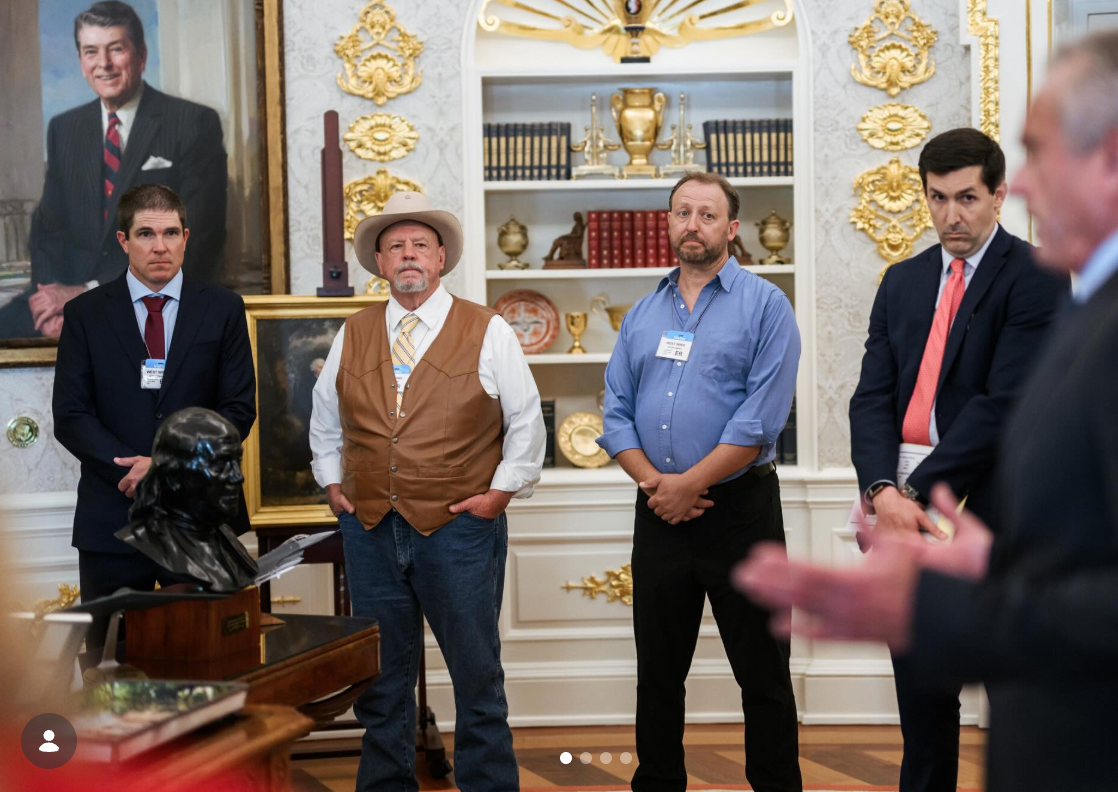
Inside the Oval Office were four regenerative farmers—Brandon Bock, Will Harris, Rick Clark, and Jonathan Lundgren—along with Calley Means, Bobby Kennedy, Secretary of Agriculture Brooke Rollins, and Zippy Duvall, president of the American Farm Bureau Federation.
President Trump began with a simple question: “What is this executive order, and what is regenerative agriculture?”
After receiving background from his team and Calley Means, the President heard directly from the farmers. They shared their journeys, their challenges, and why they believed regenerative agriculture represented an opportunity for American farmers and a healthier future for consumers.
The conversation turned to whether the President should sign the executive order. Bobby Kennedy expressed strong support. Brooke Rollins recognized the opportunity it represented. Zippy Duvall expressed concerns about how the order could be received by conventional farmers.
That disagreement reflected a much larger question facing agriculture: How do we support farmers today while creating pathways toward a healthier and more resilient future?
Ultimately, President Trump signed the executive order.
An executive order does not, by itself, allocate funding or immediately transform policy. It directs agencies—including HHS, USDA, and EPA—to continue advancing research, innovation, and implementation around regenerative agriculture.
It creates direction. It creates coordination. It creates an opening.
The Call After the Meeting
Later that day, I received a call from a member of Secretary Kennedy’s team. I was told the Secretary wanted to speak with me. A moment later, Bobby Kennedy came onto the phone.
He thanked me for helping bring the farmers and administration together and for the behind-the-scenes work that had gone into creating the opportunity.
I appreciated those words, but I still had a question. I asked him about the timing of the Supreme Court decision involving Bayer-Monsanto and whether there was any connection between that decision and the executive order.
His response was immediate. He told me the Supreme Court decision had been a gut punch to him as well, that he had expected a different outcome, and that there was absolutely no connection between the two events.
That conversation stayed with me. It is difficult to celebrate a step forward while simultaneously processing a decision that many in the regenerative agriculture community viewed as a setback. But government is a massive institution, and opposing forces can move at the same time. A difficult day for one pathway does not eliminate the possibility of progress on another.
What Happens Next?
The question now is not simply what the executive order says. The question is what happens next.
The answer will be determined by what we choose to value, what we choose to measure, what we choose to invest in, and whether we are willing to work with the biological realities of the systems that sustain us.
The executive order does not guarantee transformation. But it represents an important shift: recognition at the highest levels of government that regenerative agriculture deserves serious attention, research, innovation, and consideration as part of the future of American agriculture.
And regenerative agriculture is ultimately about something bigger than an agricultural practice or a government policy. It is about recognizing that we cannot indefinitely short-circuit the design and limitations of nature.
Healthy soil has biological limits. Healthy ecosystems have biological relationships. Human bodies have biological requirements. We can manipulate these systems for a period of time, but we cannot permanently escape the consequences of degrading the foundations on which they depend.
The health of our land, our food, and our bodies are not separate conversations. They are one connected system.
When we degrade the soil, we affect the food that grows in it. When we degrade the quality of our food, we affect human health. When human health deteriorates, the costs ripple through families, communities, healthcare systems, and the economy.
The same is true in the other direction. When we restore soil health, support biological diversity, improve the quality of our food, and create economic systems that reward stewardship, we begin creating the conditions for health to compound.
That is the cultural shift I believe this moment represents.
We need to restore value to stewardship—not simply as an environmental ideal, but as an economic, cultural, and public-health imperative. We need to reward people for taking care of the land. We need to recognize farmers not only as producers of commodities, but as stewards of the living systems that produce our food. And we need to continue investing in science that helps us understand these relationships rather than reducing complex biological systems to isolated variables.
Regeneration cannot be achieved through a single policy, technology, farm practice, or institution. It requires all the parts of the system to keep improving, adapting, and finding balance.
Farmers matter. Scientists matter. Consumers matter. Businesses matter. Healthcare matters. Government matters. And culture matters.
Each part influences the others.
That is why the Oval Office meeting mattered to me. Not because a single executive order can transform American agriculture. It cannot. It mattered because it opened a door.
For decades, regenerative farmers have been demonstrating what is possible on the ground. Researchers have been gathering evidence. Communities have been experimenting with new models. And a growing number of Americans are asking deeper questions about where their food comes from, how it is produced, and what it means for their health.
Now those conversations are beginning to converge.
The opportunity is not simply to replace one agricultural system with another. It is to rethink the relationship between agriculture, health, economics, and the living world.
If we can learn to design our institutions and incentives around the realities of biological systems—rather than continually trying to override them—we have an opportunity to build something far more resilient.
Something that can regenerate.
The executive order is only one step. The larger work is cultural.
The goal is not perfection. It is to keep moving the entire system toward greater health, greater resilience, greater stewardship, and ultimately, regeneration.
That is the opportunity in front of us. And that is the work ahead.
